Sampling and measurement: how drinking water is tested
Testing under the Drinking Water Ordinance, including sampling, may only be carried out by accredited laboratories (Section 39 TrinkwV). The federal states publish which laboratories are accredited. Anyone treating drinking water continuously with a treatment substance has the residual concentration checked daily by trained personnel; for free chlorine, a standardised colour method exists for this.
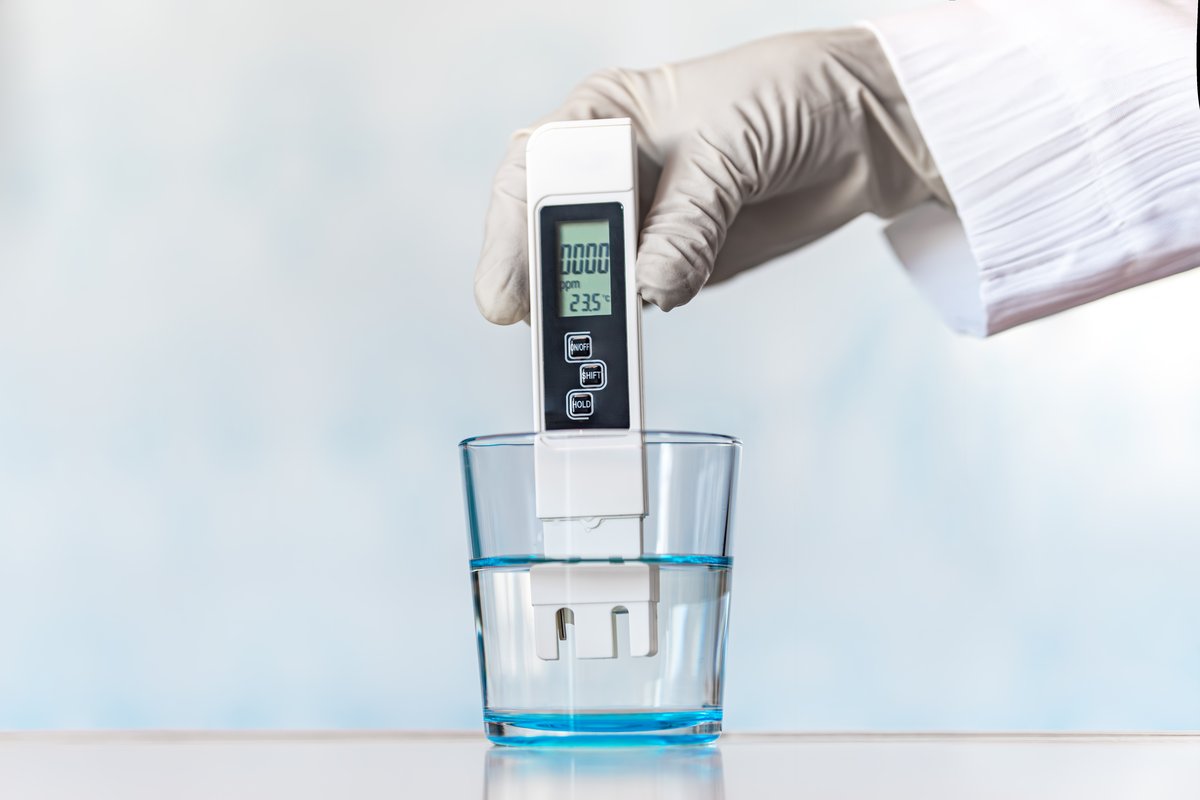
Who may take and test drinking water samples?
Under Section 39(1) TrinkwV, the tests required under the Ordinance, including sampling, may only be carried out by laboratories accredited for this purpose. The operator commissions such a laboratory. The federal states grant accreditation; they must publish lists of their accredited laboratories together with the respective scope of testing (Section 40(2)). In Bavaria, the Bavarian State Office for Health and Food Safety (LGL Bayern) is responsible, in Berlin the Landesamt für Gesundheit und Soziales (State Office for Health and Social Affairs). The LGL Bayern provides an overview with links to the lists of all federal states.
How does Legionella sampling work?
For Legionella testing, samples must be taken at several representative points (Section 41(4) TrinkwV). How this is done is described in the German Environment Agency's recommendation on systemic testing, current version of 13 October 2025:
- at the outlet of the hot-water pipe from the water heater,
- at the point where the circulation pipe re-enters the water heater,
- at peripheral outlets connected, with as short a connecting pipe as possible, to the end of the riser pipes.
For the systemic test, the Drinking Water Ordinance requires sampling under DIN EN ISO 19458, purpose b. Here, sampling takes place without a flow regulator or other fittings and after disinfecting the outlet; for Legionella, under the UBA recommendation of 13 October 2025, 1 litre is run off before the sample is taken.
What do purpose a, b and c mean?
| Purpose under DIN EN ISO 19458 | What is tested | How sampling is done |
|---|---|---|
| Purpose a | the water in the supply pipe | after thorough flushing; for Legionella testing, only for special questions |
| Purpose b | the water in the drinking water installation, generally without the fitting | without flow regulator or fittings, outlet disinfected, only minimally flushed |
| Purpose c | the water as it is consumed | through the flow regulator, without disinfection, without prior flushing; shows local contamination at the fitting |
Sources: UBA recommendation of 13 October 2025 (in German); recommendations of the State of Schleswig-Holstein on sampling (2013, 2023, in German); for purpose a, additionally a specialist publication. The standard itself is a paid document.
Which parameters are tested?
| Occasion | Parameter | Source |
|---|---|---|
| Legionella testing in the building | Legionella spec.; technical action value 100 CFU per 100 ml | Section 31 and Annex 3 Part II TrinkwV |
| Temporary system at funfairs | at least coliform bacteria, E. coli, colony count at 22 °C and at 36 °C | DVGW twin No. 15 (June 2026) |
| Treatment unit in the dental practice | colony count, guide value 100 per ml; Legionella, guide value below 1 CFU per ml | KRINKO recommendation (2006) |
How is the residual concentration of a disinfectant measured?
Anyone who treats drinking water continuously with a treatment substance must test the remaining concentration after treatment every day; the check is carried out by trained personnel (UBA list under Section 20, Table 1a). The Munich health department requires the concentration to be determined daily at the outlet closest to the dosing point, and additionally, where relevant, at hydraulically unfavourable points, with the result documented.
For free chlorine and total chlorine, DIN EN ISO 7393-2 describes a colour method for routine checks, the so-called DPD method; results are read with a colour comparator or a photometer. Separate measurement methods exist for chlorine dioxide. It is best to check with your laboratory which one suits your system.
Frequently asked questions on sampling and measurement
Can I test my drinking water myself?
You can run a rapid test at any time, but it does not replace testing under the Drinking Water Ordinance. That, including sampling, may only be carried out by accredited laboratories (Section 39(1) TrinkwV).
Where do I find an accredited laboratory?
Every federal state publishes a list of accredited laboratories with their scope of testing (Section 40(2) TrinkwV). The Bavarian State Office for Health and Food Safety (LGL Bayern) provides an overview with links to all the federal states' lists.
Where are samples for Legionella testing taken?
At the outlet of the hot water from the water heater, at the point where the circulation re-enters, and at outlets at the end of the riser pipes. This is how the German Environment Agency's recommendation of 13 October 2025 describes it.
Must I document the residual concentration of the disinfectant?
For continuous treatment, yes: check and document daily. This is what the UBA list and the guidance of the Munich health department provide for. For system disinfection, after which the water is discarded, the continuous check does not apply; there, after flushing, a check establishes whether the system again delivers flawless drinking water.
Sources
- Section 39 TrinkwV (in German), Section 40 TrinkwV (in German), Section 41 TrinkwV (in German)
- German Environment Agency: systemic testing of drinking water installations for Legionella, as of 13 October 2025 (in German)
- Schleswig-Holstein: supplementary recommendation for sampling and assessing Legionella (2023, in German)
- Schleswig-Holstein: sampling water for human use (2013, in German)
- LGL Bayern: online access to the lists of accredited laboratories (in German)
- Munich health department: guidance on the use of disinfectants (2025, in German)
- DIN EN ISO 7393-2 at DIN Media (in German)
This page does not replace legal advice or guidance from the health authority or the laboratory.